Listen to the latest episode here.

When Understanding Breaks Down Between Us: The Communication Project

Every day, we speak with the belief that our meaning is obvious — that the words we choose will land the way we intend.But meaning doesn’t travel intact. It’s built in real time, shaped by emotion, history, uncertainty, and the tiny slivers of information people actually receive.And when understanding breaks down, the consequences aren’t just confusion — they’re mistrust, fear, and the sense that institutions or individuals “aren’t being clear,” even when everyone is trying their best.On this episode of Between Us, we explore why misunderstanding is so common, why clarity is so fragile, and how people and organizations can rebuild alignment when messages drift.In This EpisodeWhy two people can hear the same message and walk away with entirely different interpretationsHow uncertainty, fear, and cognitive load shape the way families and communities “fill in the gaps”Why information alone isn’t enough — and why communication must be relational, not transactionalWhat sensemaking looks like inside school systems and public agenciesThe role of repair in communication: how to rebuild trust after misalignmentJoy’s practical insights from working in districts where clarity is essential, and misunderstanding has real stakesThis Episode’s GuestJoy Moyers is a Public Information Officer based in Orange County, California. She works in K–12 public education, helping districts navigate complex communication challenges — from everyday updates to high-stakes moments involving safety, policy changes, and family concerns.Joy holds an M.S. in Public Relations, Innovation, Strategy & Management from the University of Southern California (USC). Her work draws on systems theory, relational communication, and sensemaking to help organizations understand how messages land, how interpretations form, and how to rebuild clarity when breakdowns occur. She believes communication is not merely the transmission of information, but a social process that shapes trust, culture, and community alignment.Resources & LinksRecommended reading on systems theory, sensemaking, and organizational communication (curated at thecommproject.com)Follow Between Us wherever you listen to podcastsHost / Producer: Travis SoudersGuest: Joy Moyers© 2025 The Comm Project

Who Gets to Sound “Proper?”

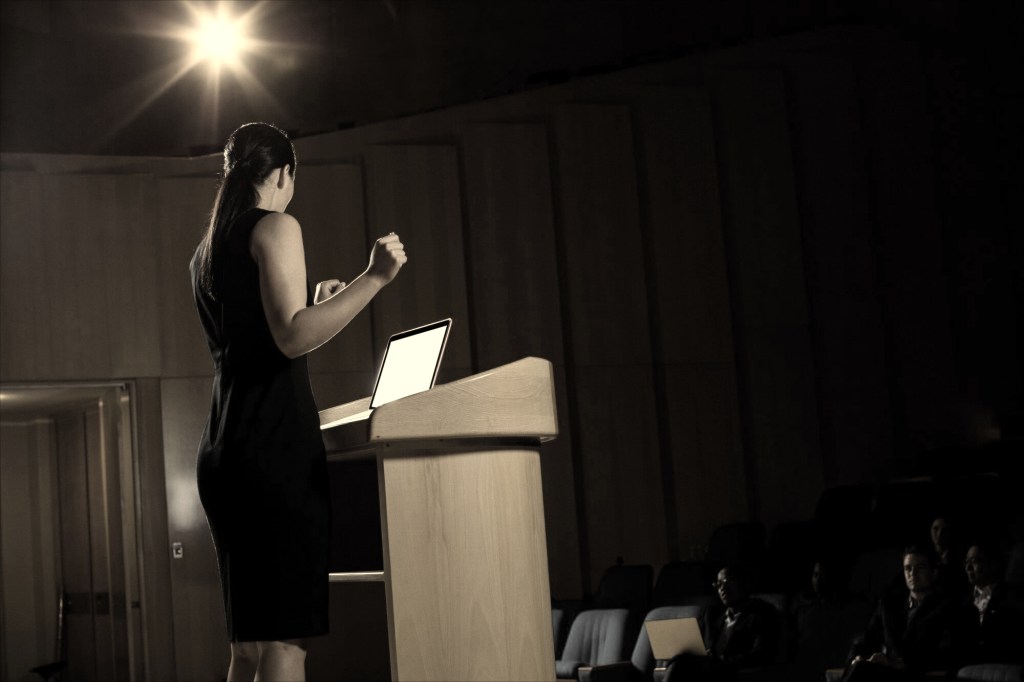
A woman in a black dress stands at a wooden podium under a bright stage light, gesturing as she speaks to a dimly lit audience in a lecture hall. The image has a muted amber tone, emphasizing the contrast between light and shadow.

Guest: Dr. Sergio Fernando Juárez
When Understanding Breaks Down Between Us: The Communication Project

Every day, we speak with the belief that our meaning is obvious — that the words we choose will land the way we intend.But meaning doesn’t travel intact. It’s built in real time, shaped by emotion, history, uncertainty, and the tiny slivers of information people actually receive.And when understanding breaks down, the consequences aren’t just confusion — they’re mistrust, fear, and the sense that institutions or individuals “aren’t being clear,” even when everyone is trying their best.On this episode of Between Us, we explore why misunderstanding is so common, why clarity is so fragile, and how people and organizations can rebuild alignment when messages drift.In This EpisodeWhy two people can hear the same message and walk away with entirely different interpretationsHow uncertainty, fear, and cognitive load shape the way families and communities “fill in the gaps”Why information alone isn’t enough — and why communication must be relational, not transactionalWhat sensemaking looks like inside school systems and public agenciesThe role of repair in communication: how to rebuild trust after misalignmentJoy’s practical insights from working in districts where clarity is essential, and misunderstanding has real stakesThis Episode’s GuestJoy Moyers is a Public Information Officer based in Orange County, California. She works in K–12 public education, helping districts navigate complex communication challenges — from everyday updates to high-stakes moments involving safety, policy changes, and family concerns.Joy holds an M.S. in Public Relations, Innovation, Strategy & Management from the University of Southern California (USC). Her work draws on systems theory, relational communication, and sensemaking to help organizations understand how messages land, how interpretations form, and how to rebuild clarity when breakdowns occur. She believes communication is not merely the transmission of information, but a social process that shapes trust, culture, and community alignment.Resources & LinksRecommended reading on systems theory, sensemaking, and organizational communication (curated at thecommproject.com)Follow Between Us wherever you listen to podcastsHost / Producer: Travis SoudersGuest: Joy Moyers© 2025 The Comm Project
  1. When Understanding Breaks Down
  2. Who Gets to Sound "Proper?"

“Use proper English.” “Talk like a professional.”
You’ve probably heard that before. But have you ever stopped to ask: “Proper,” according to whom?

Dr. Sergio Fernando Juárez has.

Sergio grew up in Santa Barbara, to many a place of wealth, beauty, harmony; a postcard version of California. But his lived experience there was something else entirely. He’d open the Santa Barbara News-Press and feel like he was reading dispatches from another country — ribbon cuttings, beachside real estate, people whose lives didn’t look anything like the one outside his window.

At home, Spanish filled the air while he and his family worked the lawns and gardens of million-dollar houses. On TV, G.I. Joe and Transformers preached that if you work hard and play fair, good things happen.
Sergio believed them — even as his own life showed him something different.

Years later, before earning his Ph.D. in Communication Studies from the University of Denver, he discovered a field that gave him the words for that feeling — a way to see how culture and power decide what counts as “normal,” who gets heard, and who doesn’t.

That realization drives his work today. He’s now an Assistant Professor of Communication Studies at Cal Poly San Luis Obispo, studying how language itself can open doors for some while slamming them shut for others — and what we might do to change that.

His latest paper in the Journal of Communication Pedagogy is Transgressing Linguistic Supremacy,” and it reimagines what we even mean by public speaking: what counts as “professional,” whose voices fit that mold, and whose don’t.

Dr. Juárez’s work shows that what we call “proper” or “professional” isn’t neutral at all. It’s learned, enforced, and designed to privilege certain voices over others.
And if we can recognize that, maybe we can start imagining a new, fairer kind of proper speech.

Published by

Leave a comment